
Exercise 4 hours after studying beats doing it right away
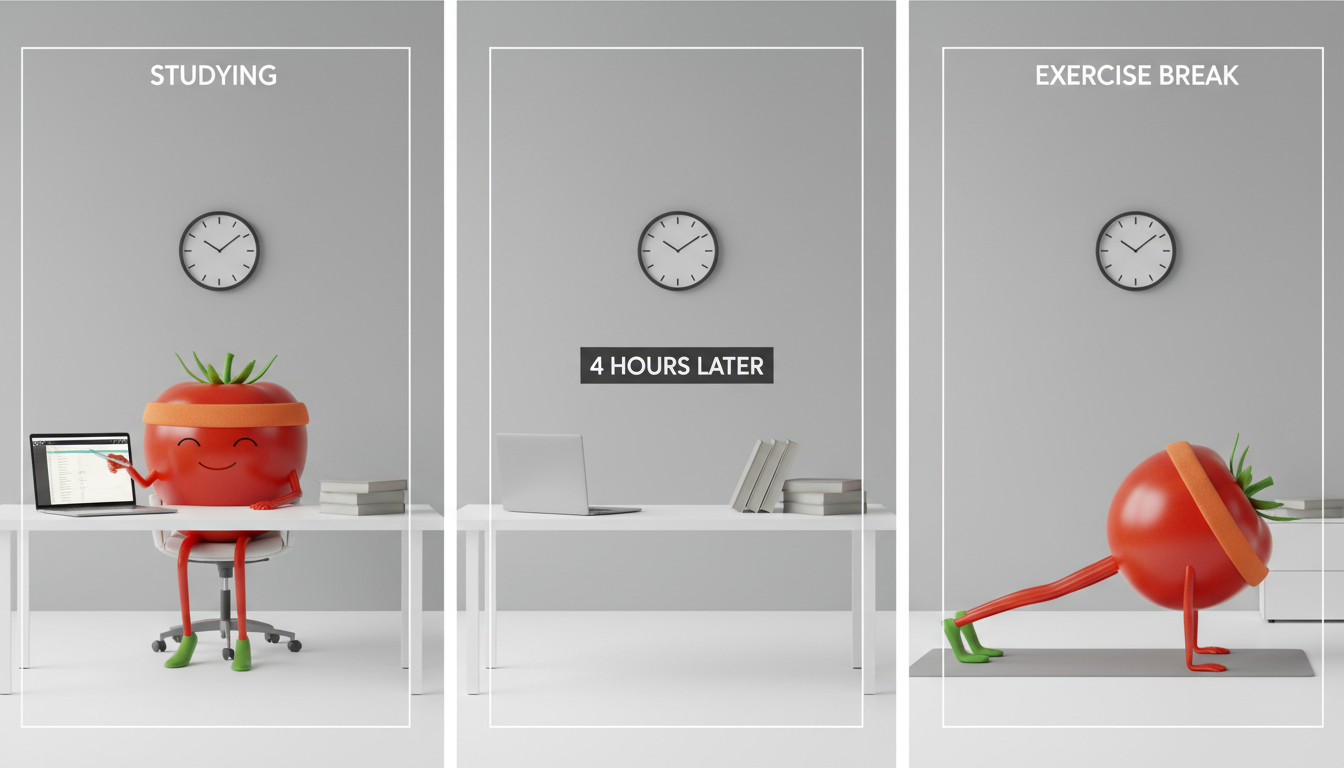
Most developers who exercise do it first thing in the morning or right after work. A 2016 study from Radboud University suggests that's probably the worst time if your goal is to retain what you learned.
The study
Researchers split participants into three groups. All of them learned a set of picture-location associations. Then:
- Group 1 exercised immediately after learning
- Group 2 exercised 4 hours after learning
- Group 3 did not exercise
Forty-eight hours later, the 4-hour delay group retained significantly more than both other groups. The immediate exercise group performed no better than the no-exercise group.
The difference wasn't small. Memory retention in the delayed group was measurably higher - about 20% better recall compared to the no-exercise group.
Why timing matters
Your brain doesn't just record memories during learning. It consolidates them over the hours after - moving information from short-term into long-term storage. This process involves norepinephrine, a neurotransmitter that "tags" memories for retention.
Exercise triggers a norepinephrine spike. If that spike happens immediately after learning, it overlaps with the initial encoding phase and can actually interfere with the signal. But if it happens 4 hours later, during the consolidation window, the norepinephrine spike strengthens memories that are already in the process of being stored.
The timing aligns with the brain's natural processing schedule, not against it.

What this means for developers
If you spend the morning reading a new codebase, learning a framework, or working through documentation - that's when the consolidation clock starts. An exercise break in the early afternoon isn't just good for your focus. It may be actively strengthening what you learned four hours earlier.
This is a different way to think about when to schedule breaks. Most people fit exercise around their calendar. The research suggests you could fit it around your learning sessions instead.
Read documentation in the morning. Deep code implementation in the late morning. Movement break around early afternoon. The knowledge from the morning session gets a consolidation boost at exactly the right time.
You don't need to redesign your whole day. But knowing the mechanism means you can get more out of the breaks you're already taking.
Movedoro fires a break timer on a Pomodoro schedule. If you do your heaviest studying in the first half of your day, that midday or early afternoon break isn't just a rest - it's the consolidation window. Use it.
That's pretty much it.