
Your Focus Has a Battery Life (And You're Draining It Wrong)
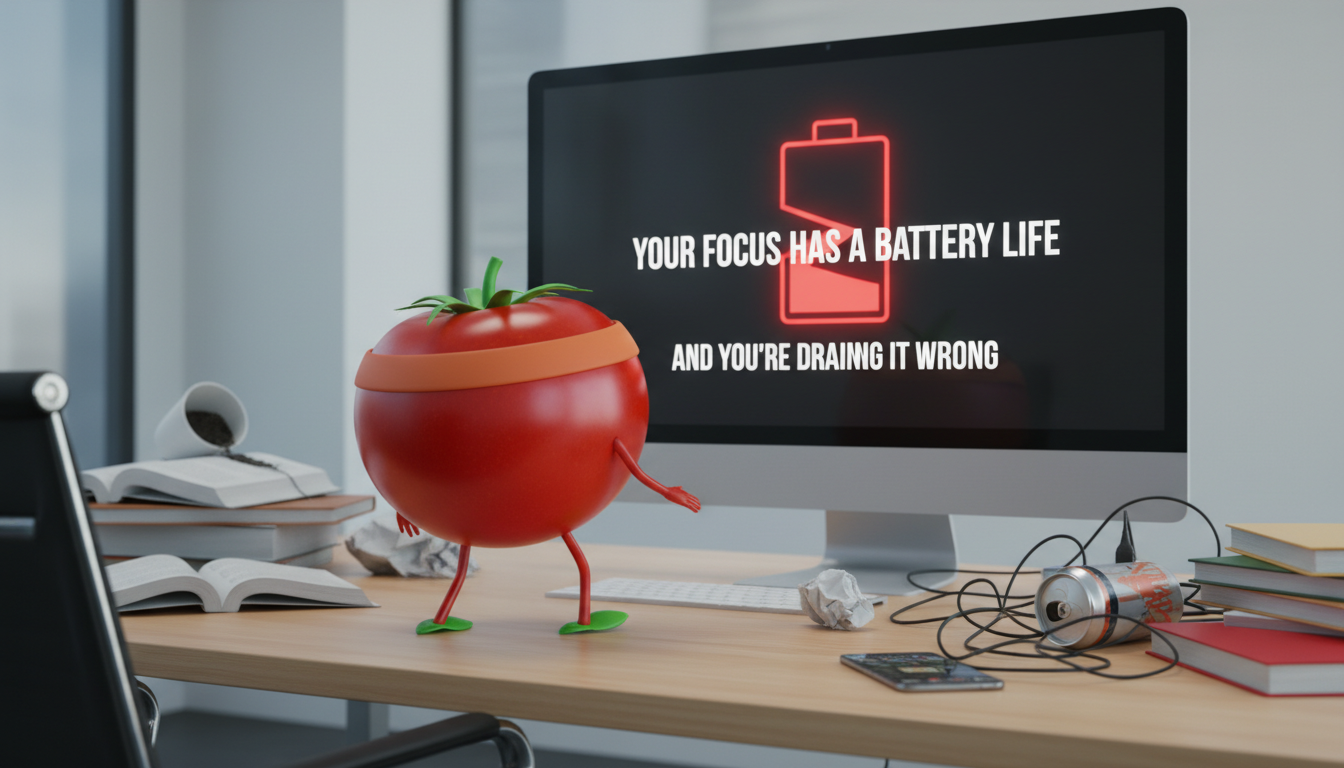
You check your phone battery constantly. 47%? Better find a charger.
But your focus battery? You run that thing into the ground every single day.
New productivity research for 2026 confirms what experts have been saying. Focus is now treated like battery life. It drains. It needs recharging. And most of us are doing it completely wrong.
The Shift Everyone Missed
2026 marks a fundamental change in how we think about productivity. The biggest trend isn't a new tool or hack.
It's the shift from "doing more" to "protecting energy."
Companies are eliminating entire days of meetings. Teams are simplifying systems. The goal isn't output anymore. It's sustainable focus.
Your brain isn't a machine that runs until you shut it down at night. It's a battery that depletes throughout the day.
You're Already Running on Empty
Here's what drained focus actually looks like.
You sit down to work. You open your editor. You stare at the code. Nothing happens.

It's not writer's block. It's not lack of motivation. Your focus battery is dead.
You switched between Slack, email, your codebase, documentation, and Stack Overflow 50 times this morning. Each switch drained a little more charge.
Now you're at 3%. And you're trying to solve a complex problem that needs 80%.
The Numbers Don't Lie
51% of employees say lack of time prevents them from recharging through exercise or movement.
Think about that. Half of all workers know they need to recharge. But they can't find the time.
They're running their focus battery at 10% all day, every day. Then wondering why they feel fried.
Research shows microbreaks make a measurable difference. Just 5-10 minutes every hour improves your ability to return to deep work.
But we skip them. Because we're "too busy."
The Wrong Way to Recharge
You hit a wall. Your brain is fried. So you open Twitter.
You scroll for 10 minutes. You feel worse. You go back to work even more depleted than before.
That's not recharging. That's switching from one cognitive drain to another.
Your prefrontal cortex doesn't rest when you scroll. It just processes different inputs. The battery keeps draining.
Real recharging requires physical movement. Not more screen time.
Movement Recharges Your Brain
When you move, your brain actually recovers. It's not metaphorical.
Physical activity increases blood flow. It reduces cortisol. It gives your decision-making systems a break.
You don't need an hour at the gym. The research shows 5-10 minute movement breaks work.
Stand up. Do squats. Walk around your apartment. Anything that gets your body moving.
When you sit back down, your focus battery has recharged. Not to 100%, but enough to handle the next deep work session.
The System That Actually Works
I built Movedoro because I kept forgetting to recharge. I'd work for 4 hours straight, then wonder why I couldn't think clearly.
Every 25 minutes, your screen locks. You move for 2 minutes. That's it.
Your focus battery gets regular recharges throughout the day. You never hit zero. You stay functional.
It's not about fitness. It's about treating your focus like what it actually is: a limited resource that needs active management.
You wouldn't run your laptop at 5% all day. Don't do it to your brain.