
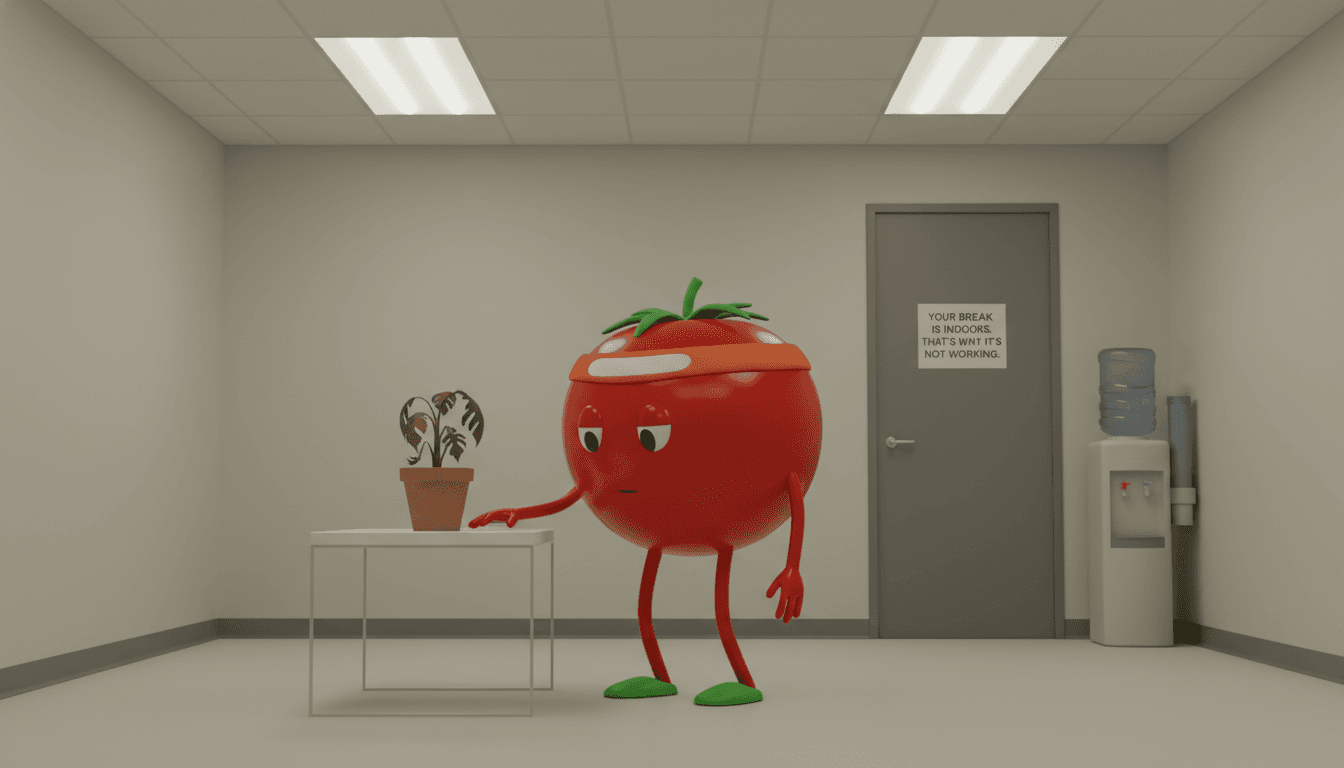
Your break is indoors. That's why it's not working.
There's something most of us get wrong about breaks.
We step away from the screen, walk to the kitchen, pace around the office, or scroll Twitter standing up. We call it a break. But research says it's not restoring the thing you've been depleting.
What the EEG data shows
A 2024 randomized controlled trial published in Scientific Reports tested this with 92 participants. Half took a 40-minute walk in nature. Half walked the same distance through an urban environment.
Both groups felt better afterward. But the EEG data told a different story.
The urban walkers showed significantly higher frontal midline theta activity - a neural marker that indicates your executive attention is still working hard. The nature walkers didn't. Their executive attention had actually recovered.
The researchers also measured error-related negativity, a brain signal linked to your ability to catch and correct mistakes. After the nature walk, it improved. After the urban walk, it didn't change.
Your brain, walking through city streets, is still doing cognitive work. Processing traffic, reading signs, navigating pedestrians. Lower-effort than coding, but not recovery.

Why nature is different
Attention Restoration Theory has a framework for this. Natural environments engage your attention passively - your eyes wander to trees, light through leaves, a bird somewhere. There's nothing you need to do with any of it.
Contrast that with a city walk, or staring at your phone, or even pacing your apartment. These environments constantly request micro-responses. Stay alert. Don't bump into anything. Keep scanning. The micro-demands add up.
A 2025 follow-up study on repeated short-duration nature walks confirmed: even brief outdoor exposure reduces cortisol and improves cognitive function. It doesn't need to be 40 minutes. But you do need to leave your phone in your pocket. Scrolling outside is still scrolling.
What this means in practice
Most breaks happen indoors. You refill your coffee, check Slack, walk to another room. Nothing wrong with that. But if you're feeling drained by early afternoon, it's worth questioning where you're taking your breaks, not just whether you're taking them.
A five-minute walk outside - real outside, away from your screen and your notifications - seems to work through a different mechanism. Your executive attention isn't just resting. It's actually recovering.
I started swapping one of my afternoon Movedoro breaks for an outdoor walk. No phone, no podcast. Just outside. The difference in how the next focus session feels is noticeable enough that I've kept doing it.
That's pretty much it.


