Your brain needs sunlight before code
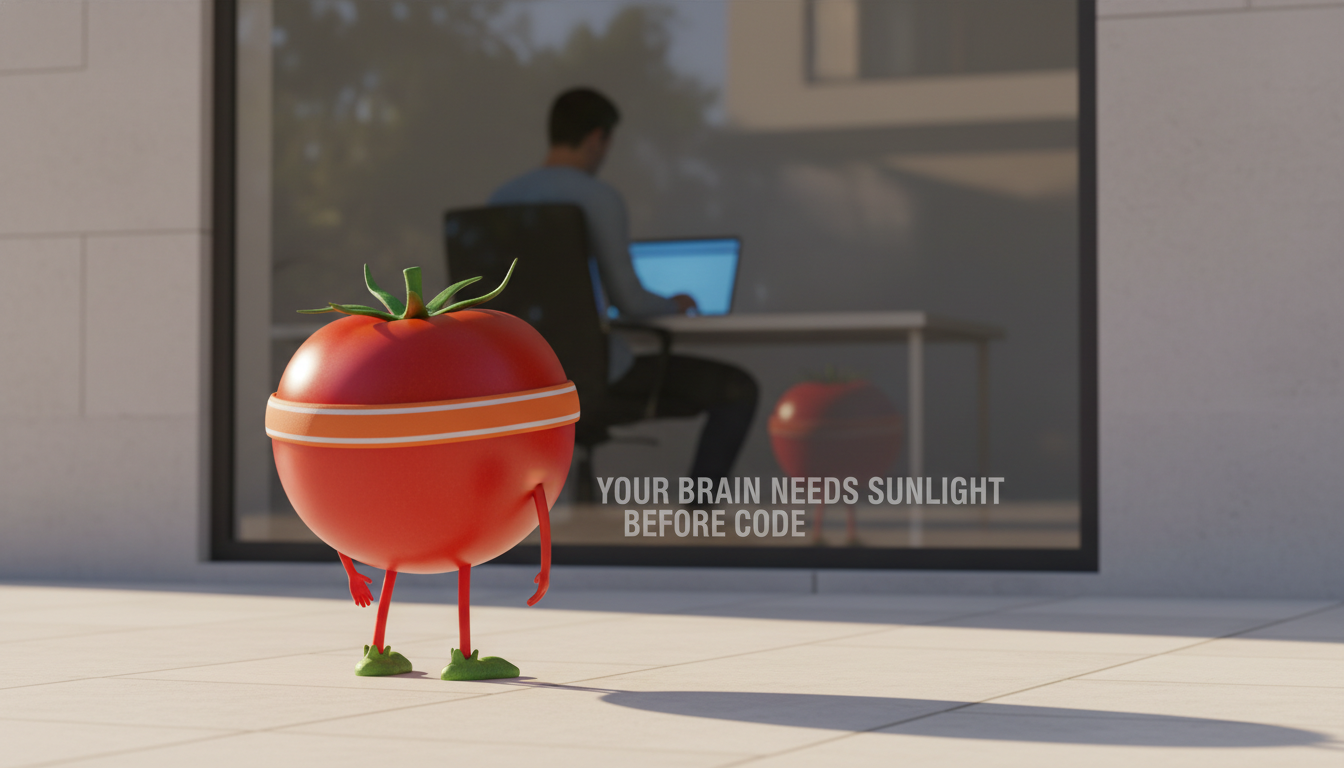
The first thing most developers do after waking up is check their phone. Then coffee, then the laptop. The day starts inside a screen before your body even knows what time it is.
That sequence is working against you in a specific, measurable way.
What morning light actually does
Your brain has a master clock in a region called the suprachiasmatic nucleus. It coordinates when you feel alert, when you're tired, when cortisol peaks. The primary input it uses to calibrate that clock is light - specifically, the wavelengths in natural morning sunlight.
When your eyes receive sunlight in the first hour of waking, your body releases cortisol and serotonin simultaneously. Not the stress cortisol - the alertness kind. That combination is the biological signal for your brain to start running at full capacity.
Skip the sunlight, and the clock drifts. You still function, but your peak alertness window shifts later. Focus feels harder to reach. Coffee picks up some of the slack, but not all of it.
What the research says
Andrew Huberman has covered this extensively at Stanford. The recommendation is straightforward: 10-30 minutes of natural light exposure within the first hour of waking. Outside. No sunglasses. Even on overcast days, outdoor light intensity is many times higher than indoor lighting, even near a bright window.
You don't need to stare at the sun. Walking outside, drinking coffee on a patio, or even just standing near your front door works. The point is your eyes are receiving outdoor light while your circadian system is most sensitive to calibration.
El Camino Health research describes morning sunlight as "a natural reset button" for circadian rhythm - not a wellness trend, but a basic biological input your brain requires to time itself correctly.

What changed for me
I started doing this a few months ago. Not a dramatic protocol - just 10 minutes outside before sitting down to work.
Getting into deep focus used to take 20-30 minutes of fighting the fog. That fog mostly disappeared. I'm not claiming this is the only variable, but I stopped having mornings where the first session felt like pushing through mud.
The broader research on circadian-aligned routines shows improvements in mood, attention, and cognitive performance across the entire day - not just in the morning. You're setting a baseline for how your whole neurology runs.
One thing to stack on top
If you want more from this, delay your first caffeine 90-120 minutes after waking. Your cortisol peaks naturally in that window. Drinking coffee during the cortisol spike builds tolerance faster and adds less benefit. Coffee after the peak is where it actually works.
Morning sunlight for the first two hours, then caffeine for the window after that. You're not fighting your biology - you're timing things with it.
I use the first Movedoro break to step outside on days when the morning walk isn't possible. Five minutes of outdoor light partway through the morning session is a reasonable fallback.
That's pretty much it.