
Top performers work 75 minutes then stop
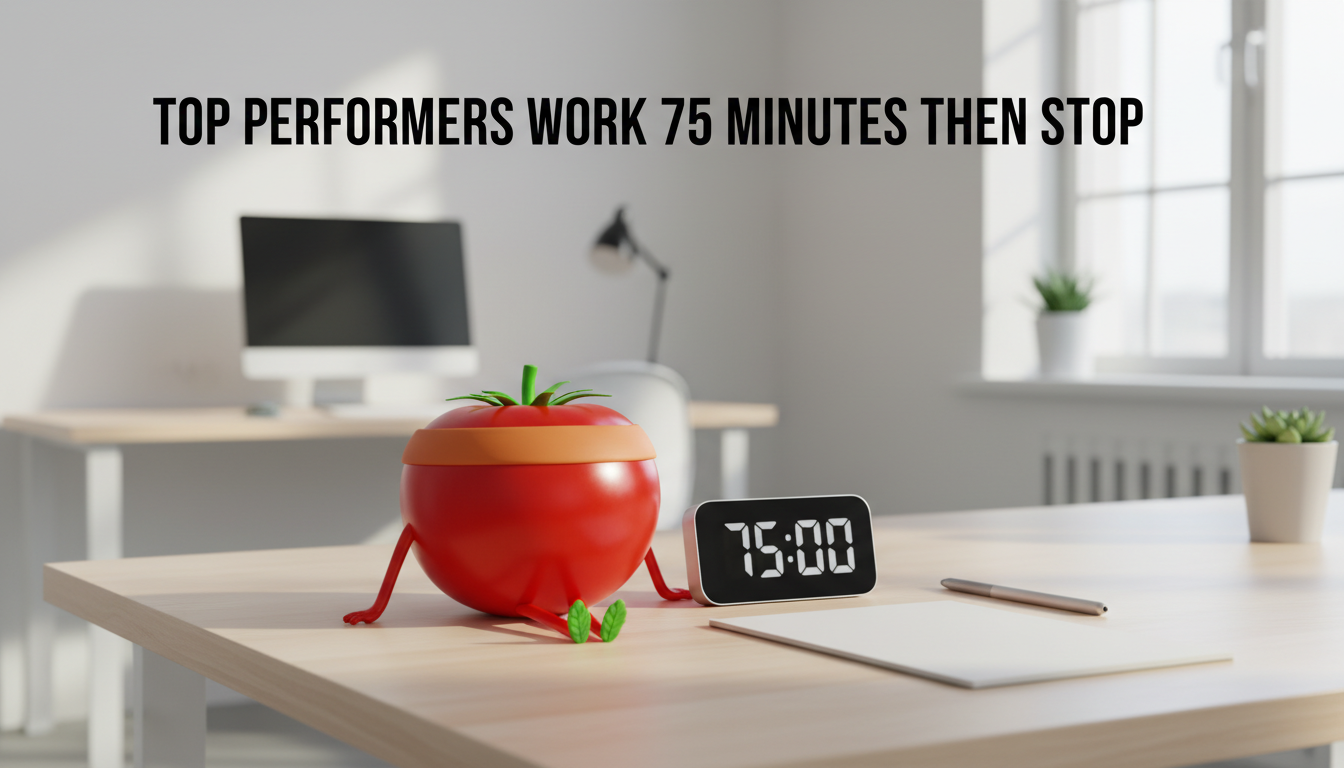
DeskTime analyzed thousands of workers and found that the most productive ones averaged 75 minutes of focused work followed by 33 minutes of rest.
Not 25 minutes. Not "whenever I feel like it." A consistent 75-minute block, then a real break.
The biology behind it
In the 1950s, sleep researcher Nathaniel Kleitman discovered the Basic Rest-Activity Cycle (BRAC). He found the brain cycles through 90-120 minute periods of high alertness and recovery - not just during sleep, but throughout the entire day.
During the first half of a cycle, your brain runs at near-peak capacity. Attention is sharp, working memory is full, complex reasoning feels effortless. Then the back half arrives. Your mind wanders. You start fidgeting. You check your phone without meaning to.
Those aren't signs of weak willpower. They're your brain signaling the end of a high phase.
What happens when you ignore it
Most people push through the dip. They stay at the desk and grind. What they're actually doing is borrowing from the next cycle. The recovery that should happen in the rest phase gets skipped, and the next focus block starts from a lower baseline.
Studies on professionals who align with their ultradian rhythm report 50% less mental fatigue compared to those who don't. The work doesn't decrease - the exhaustion does.

How the 25-minute Pomodoro fits in
The traditional 25-minute timer isn't wrong. It's just incomplete. You're getting micro-focus blocks, but you're often cutting the high phase short before you reach the peak output zone.
A useful hybrid: stack three Pomodoros back-to-back with short micro-breaks between them. That adds up to roughly 75-90 minutes of deep work. Then take a longer recovery break before starting the next cycle. You get the focus cues from the shorter timers without leaving the peak phase early.
The key is the longer recovery. A 5-minute break between Pomodoros is fine. But the 20-30 minutes after the full block is what actually recharges you.
What I changed
I stopped treating all breaks as equal. The short micro-breaks between sessions are for resetting attention. The longer recovery windows at the end of a full block are for actual rest - no screens, no Slack, ideally movement.
I use Movedoro to track both. The short timers mark the micro-breaks. The longer break at the end of a cluster is where the real recovery happens. Once I stopped compressing the rest phase, the next focus block started sharper.
That's pretty much it.