
Procrastination isn't a time problem (your brain is just scared)
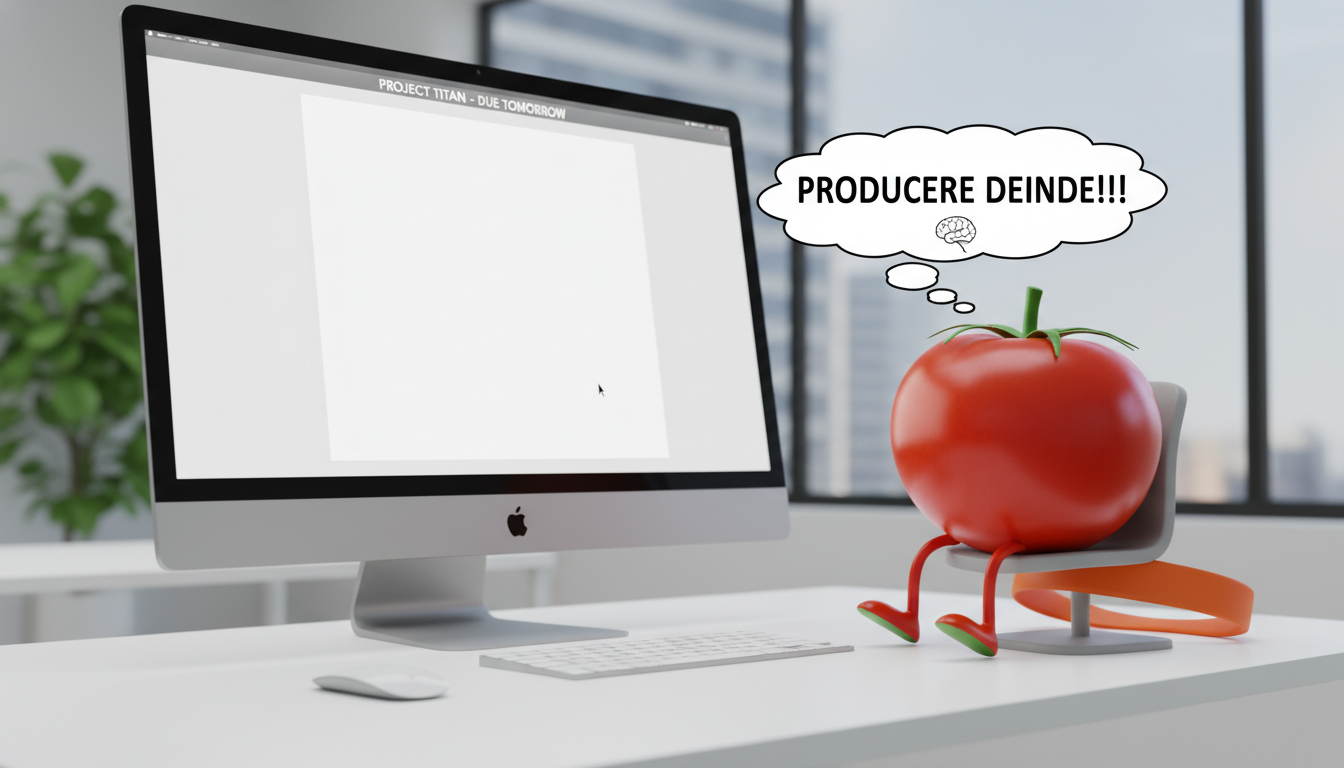
You already know what you need to do. You have a calendar, maybe even a Pomodoro timer. You're not confused about the task. You just can't start it.
That's not a time management problem.
The real reason you're not starting
A 2025 meta-analysis published in Frontiers in Psychiatry reviewed the evidence and landed on a clear conclusion: procrastination is primarily an emotion regulation failure. You delay tasks not because your schedule is wrong, but because starting the task triggers negative emotions - anxiety, dread, uncertainty, fear of doing it badly - and your brain decides avoiding the feeling is more important than doing the work.
The mechanism is straightforward. Your prefrontal cortex knows you should start. Your limbic system feels the discomfort of the task and pumps the brakes. When stress is elevated or the task feels threatening, the limbic system wins. Avoidance provides immediate mood relief. That feels better right now, which reinforces the avoidance.
It's a habit loop, not a character flaw.

Why more structure doesn't fix it
Most productivity advice responds to this by adding structure. Better to-do lists. Time blocking. Accountability partners. These help some people, but they target the scheduling layer, not the emotional one.
If the task itself feels aversive - if opening that document or making that call creates a small internal alarm - then a tidier calendar doesn't change anything. You'll just feel organized while not doing it.
The research points to a different lever: lower the emotional cost of starting. Not the time cost. The emotional cost.
What actually helps
The evidence points to a few things that work at the emotion layer:
Self-compassion over self-criticism. Studies consistently find that harsh self-judgment after procrastinating increases avoidance. Treating yourself the way you'd treat a colleague in the same situation lowers the emotional stakes enough to re-engage.
Shrink the starting action. Not "work on the report" but "open the document and write one sentence." The goal isn't a small task - it's a small action that gives your limbic system proof the task isn't actually as threatening as it imagined.
Separate starting from finishing. Most of the dread is front-loaded. Once you're in the task, the feeling shifts. The problem is the threshold, not the work itself.
This is where Pomodoro timing helps more than people realize - not as a scheduling trick, but as an emotional one. Twenty-five minutes is short enough that your brain can't credibly argue it's overwhelming. You're not committing to finishing. You're committing to starting, for a bounded window, after which you stop. That's a much easier sell to a nervous limbic system.
That's the whole idea behind Movedoro. Run a timer, take the break, keep the threshold low.
That's pretty much it.