
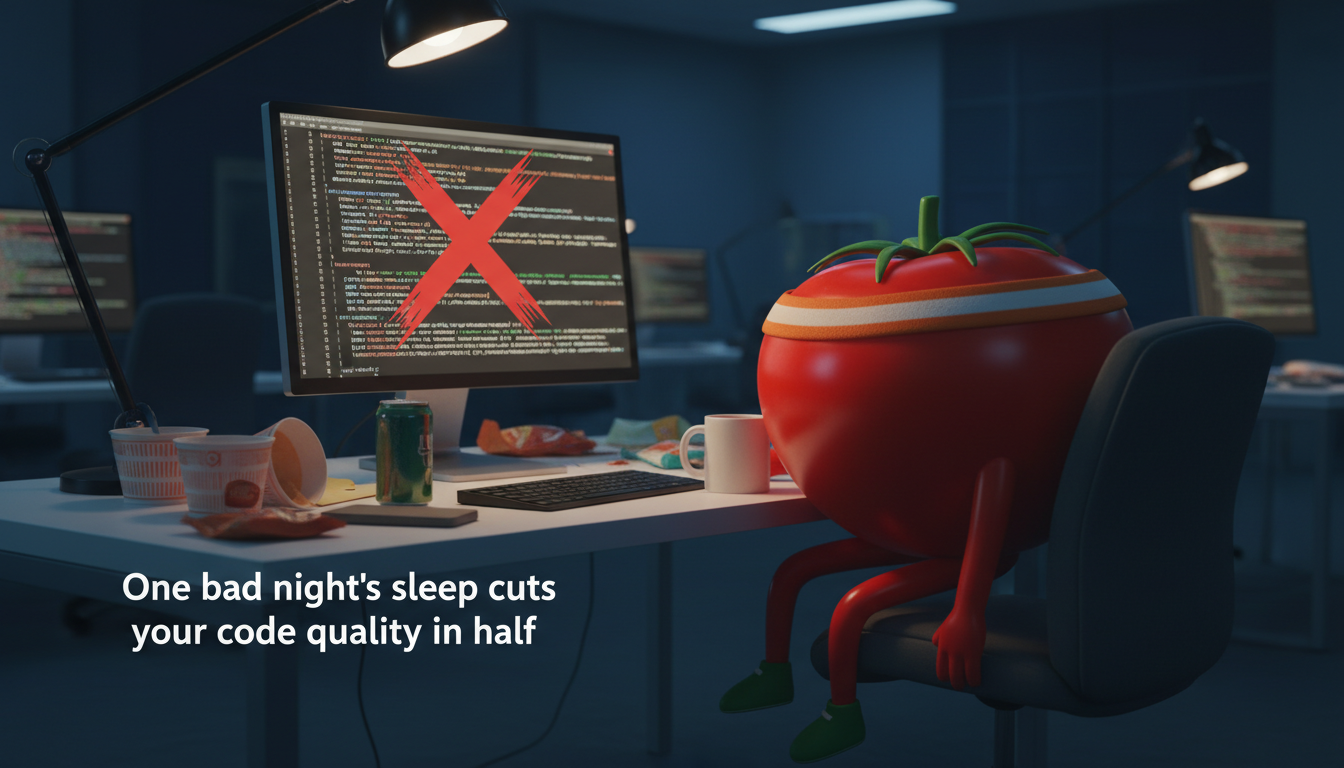
One bad night's sleep cuts your code quality in half
There's a study from IEEE that I keep coming back to.
Researchers split 45 developers into two groups. One group slept normally. The other stayed awake all night. Then both groups tackled the same programming task.
The sleep-deprived group produced code that was 50% less likely to meet the functional requirements.
Half. From one bad night.
It's not just about being tired
The sleep-deprived developers didn't just feel worse. They actually performed worse in measurable ways. More syntax errors. More time spent fixing mistakes. Lower engagement with the test-first approach they were supposed to follow.
They were slower AND produced lower quality work. A double hit.
The frustrating part is that tired developers often don't realize how much their work is suffering. You feel like you're coding, like you're getting things done. But the output tells a different story.

The culture makes this worse
There's this weird badge of honor around sleeping less in tech.
The developer who worked until 3am. The hackathon where everyone pushed through. The sprint where the team "did what it took."
But those late nights probably cost more in defects and rework than they produced in features. You can't see it in the moment. You can only see it later when you're debugging code that made perfect sense at 2am.
Sleep isn't a soft benefit. It's when your brain consolidates what you learned, clears out waste, and prepares for the next day's problem-solving. Skip it and you're running the next day on hardware that hasn't been maintained.
What this has to do with breaks
Here's the connection I didn't expect.
The same research community that studies sleep deprivation also studies cognitive fatigue during the workday. The mechanism is similar. When you work without breaks, your brain accumulates fatigue that looks a lot like mild sleep deprivation.
Your error rate goes up. Your ability to hold complex context in working memory drops. You miss things.
Movement breaks counteract this. Not because exercise replaces sleep - it doesn't. But because regular movement interrupts the fatigue accumulation cycle. You come back slightly restored each time.
I built Movedoro around this: a forced two-minute movement break every 25 minutes. It's not a replacement for sleep. But it does mean you're operating closer to your actual capacity throughout the day, not running on fumes by 3pm.
The IEEE study is a good reminder that your brain is physical hardware. It needs maintenance. Both overnight and during the day.
That's pretty much it.